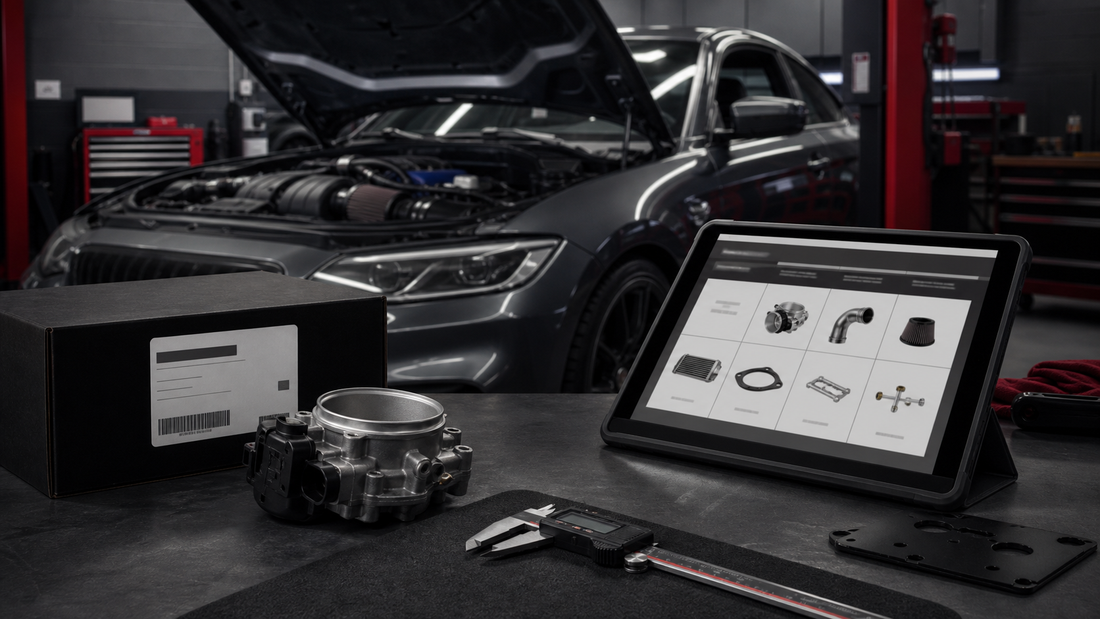
A turbo upgrade should begin with a power goal, an engine-health assessment and a complete systems plan—not with the largest compressor that fits. The turbo must work with the engine, fuel supply, charge-air cooling, exhaust, calibration, drivetrain and intended use. Supporting modifications are application-specific, so use this checklist to identify questions for the parts manufacturer, tuner and installer rather than as a universal shopping list.
Key takeaways
- Verify mechanical health before adding airflow and cylinder pressure.
- Choose the turbo around measured airflow goals, response and operating range.
- Fuel delivery and professional calibration are core requirements, not optional add-ons.
- Cooling, oiling, heat control and drivetrain capacity determine repeatability and reliability.
1. Define the actual build goal
Document the vehicle, engine, transmission, fuel, intended power range and primary use. A responsive daily driver, road-course car, drag build and towing application impose different turbine, cooling and drivetrain demands. Include altitude, climate, emissions requirements and available fuel quality.
A target should be supported by the engine and transmission platform, not chosen from a single dyno post. Discuss realistic wheel or crank output, response threshold and duty cycle with an experienced platform specialist.
2. Establish engine health
Resolve oil consumption, cooling problems, misfires, fuel-pressure faults and existing diagnostic codes first. Depending on the platform and build level, assessment can include compression or leak-down testing, crankcase-pressure evaluation, oil analysis, borescope inspection and verification of timing-system condition.
A healthy stock engine can sometimes support a planned increase, while another application may require pistons, rods, fasteners, bearings or machine work. Use platform data and measurements rather than assuming every engine of the same family has identical condition.
3. Size the turbo as a system
Compressor airflow, pressure ratio and efficiency must suit the engine and goal. Turbine sizing, housing area and exhaust manifold design influence response and backpressure. Larger is not automatically better: an oversized turbo may operate inefficiently or deliver power outside the useful range.
| System | Questions to answer | Common oversight |
|---|---|---|
| Engine | Health, compression, airflow and safe operating range | Adding boost to an unresolved fault |
| Fuel | Fuel type, pump, injectors, pressure control | Sizing only injectors |
| Charge air | Intercooler capacity, pressure drop, piping | Choosing by core size alone |
| Exhaust | Manifold, turbine outlet, catalyst and legality | Ignoring backpressure and heat |
| Calibration | ECU support, sensors and safeguards | Driving before correct tuning |
| Drivetrain | Torque capacity and intended use | Planning only peak horsepower |
4. Plan the fuel system
Fuel demand increases with airflow and target mixture. Evaluate injectors, high- and low-pressure pumps where applicable, lines, filters, rails, pressure sensors and electrical supply. Direct-injection platforms can have separate pressure limitations and may require supplemental strategies designed specifically for the application.
Fuel type affects required volume, material compatibility and cold-start behavior. Build in appropriate margin and verify pressure under load through safe professional testing.
5. Choose charge-air cooling
An intercooler should provide adequate heat rejection without unacceptable pressure drop or poor fitment. Core design, frontal airflow, ducting, end tanks and repeated pull or lap behavior matter. Charge piping needs secure bead-rolled ends where specified, suitable couplers, clearance and provisions for sensors or valves.
A larger core can add volume, block other heat exchangers or create fitment problems. Select using application data, not dimensions alone.
6. Address oil, coolant and crankcase systems
The turbo requires a correct oil feed and drain arrangement. Restrictors, fitting sizes, drain angle and oil type are turbo- and engine-specific. Water-cooled units also require properly routed coolant lines. Heat shielding must protect hoses, wiring, brake components and body panels.
Higher cylinder pressure can increase blow-by. Evaluate the positive crankcase ventilation system and use only application-appropriate catch-can or ventilation solutions that preserve required operation and legality.
7. Plan boost control and bypass strategy
Wastegate size, spring pressure, control solenoid and ECU strategy must work together. Use conservative mechanical spring pressure as directed and allow the calibration to add control only within the system's capability. Choose blow-off or bypass-valve architecture that matches whether airflow is metered and how the ECU expects recirculation.
8. Build the exhaust and heat plan
Manifold durability, turbine outlet, downpipe, catalyst, oxygen-sensor placement and exhaust diameter influence performance and compliance. Requirements differ by jurisdiction. Verify current road and emissions rules for every part; competition-use components should not be represented as street legal.
Use appropriate shields, blankets or coatings according to component instructions, and preserve clearance around fuel, oil and electrical systems.
9. Calibration and monitoring
Do not operate a major turbo change under load without the required calibration. A qualified tuner should configure fuel, ignition, boost control, torque management and safety limits using appropriate logs and test equipment. Relevant monitoring may include air-fuel ratio, fuel pressure, boost, knock response, oil pressure and temperature, coolant temperature and intake-air temperature.
10. Drivetrain, brakes and tires
Added torque can expose clutch, transmission, axle, differential and mount limitations. Match capacity to torque delivery and use rather than a marketing “stage.†Tires and brakes must suit the resulting speed and duty cycle. Chassis condition and alignment remain fundamental.
How to choose the right parts for your vehicle
- Confirm exact vehicle, engine, drivetrain, trim and production details.
- Set a realistic power, response and use target with the tuner.
- Assess engine and cooling-system health.
- Create matched turbo, fuel, intercooler, exhaust and calibration specifications.
- Verify sensors, lines, fittings, gaskets and hardware before disassembly.
- Plan drivetrain, tire and brake requirements.
- Confirm emissions and road-use requirements.
- Arrange professional installation, startup checks and tuning.
Pre-start checklist
- Oil feed primed and drain routing verified
- Coolant system filled and bled as specified
- Fuel and oil connections leak-checked
- Charge pipes secured and pressure-tested
- Wiring, hoses and heat shields clear
- Correct calibration loaded before operation
- Wastegate reference and valve routing verified
- Monitoring and shutdown plan ready
Browse FSP forced-induction components, intercoolers and confirmed vehicle-specific products. Coordinate manufacturer part numbers with the installer and tuner before ordering.
Frequently asked questions
Can I install a larger turbo without tuning?
A changed turbo commonly requires calibration. Follow the exact application and tuner requirements before operating under load.
Do I always need larger injectors?
Fuel-system needs depend on engine, target, fuel and existing capacity. Measure and plan the whole system.
Is a larger intercooler always better?
No. Pressure drop, ducting, airflow, volume and fitment matter with heat rejection.
Should the clutch be upgraded first?
Assess its torque capacity and condition against the planned torque curve and use.
Safety and legality note: Forced-induction work affects fuel, heat, lubrication and engine control. Use qualified installation and tuning, verify all local requirements and never road-test unsafe or uncalibrated changes.