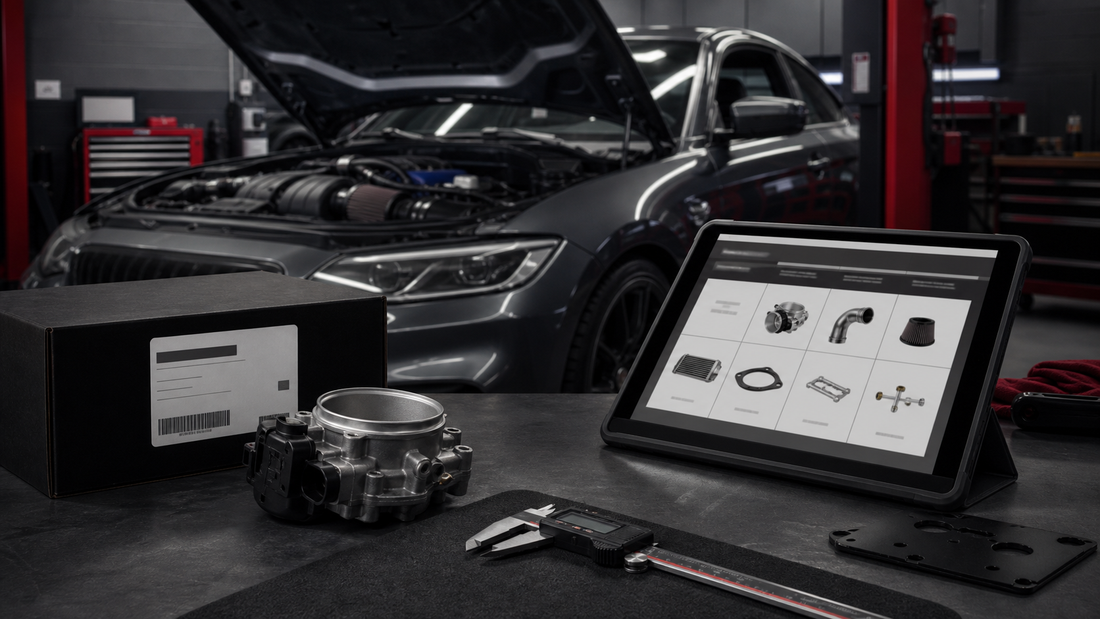
A cold air intake should be selected for the exact vehicle and engine, not by tube diameter or filter appearance alone. A properly engineered system manages the complete path from the cool-air source to the throttle body or turbo inlet while preserving sensor behavior, sealing and underhood clearance. Start with confirmed fitment, then compare airbox design, filter media, construction, maintenance and local emissions requirements.
Key takeaways
- Verify year, make, model, generation, engine, drivetrain, trim and manufacturer part number.
- MAF housing dimensions and sensor placement can directly affect drivability.
- An enclosed or well-sealed cool-air path matters more than marketing language.
- Do not assume a universal horsepower gain; results depend on the vehicle and calibration.
What a cold air intake changes
The factory intake filters air, controls noise, manages water and debris and supplies predictable airflow to the engine-management system. An aftermarket intake may change the filter, airbox, inlet location, tubing, resonators and sensor housing. These changes can increase induction sound and may reduce restriction in a system where the factory path is limiting.
Actual performance depends on engine demand, intake-air temperature, pressure loss, sensor strategy and calibration. Treat manufacturer data according to its stated test vehicle and conditions rather than applying it universally.
Exact fitment comes first
Vehicles sharing a model name can use different engines, sensor housings, turbo inlets, body panels and emissions equipment. Production dates and regional specifications can also matter. Match the product's manufacturer part number and application notes to the complete vehicle configuration.
Review whether the kit fits factory hardware only or supports specific aftermarket turbo inlets, throttle bodies, strut braces or engine covers. Confirm right-hand or left-hand-drive limitations where listed.
Airbox and inlet location
A useful cold-air design draws from outside the hottest engine-bay zone and limits recirculation of radiator and exhaust heat. An enclosed box can isolate the filter, while a well-designed shield may use the hood and factory seals to create a barrier. The effectiveness depends on sealing and the available cool-air feed.
Low-mounted filters may access cooler air but can face greater water and debris exposure. Consider the vehicle's climate, road depth, splash protection and service access. No intake should encourage driving through water.
| Feature | What to evaluate | Potential tradeoff |
|---|---|---|
| Enclosed airbox | Seal and cool-air feed | Cost and service access |
| Open filter with shield | Barrier coverage and hood sealing | More heat exposure at low speed |
| Low filter location | Cool-air access and splash protection | Water and debris exposure |
| Larger tubing | Engine demand and sensor calibration | Fitment or MAF scaling issues |
MAF and other sensor compatibility
Many vehicles measure incoming air with a mass-airflow sensor. Housing cross-section, sensor orientation, nearby bends and airflow turbulence can change the reading. A kit designed for the factory calibration should state that clearly. Some applications require tuning or a specific calibration.
Check all breather, vacuum and emissions connections. The kit should provide secure provisions rather than leaving hoses stretched, kinked or vented incorrectly. Never relocate sensors casually.
Filter media and size
Dry synthetic, oiled cotton-style and other media have different service instructions. Evaluate filtration, replacement availability, cleaning process and exposure to dirt or moisture. An oversized filter is useful only if it fits safely, seals correctly and serves the system's airflow needs.
Oiled media must be serviced with the correct amount and product. Excess oil can create problems in some sensor-equipped systems. Follow the filter manufacturer's procedure rather than a generic cleaning routine.
Tube material and construction
Aluminum, stainless steel, molded plastic and composite tubing differ in weight, heat transfer, shaping and resonance. Material alone does not establish quality. Look for smooth transitions, secure mounting, bead-rolled ends where required, correctly sized couplers and clearance from moving or hot components.
Sound and daily use
Removing resonators and opening the filter area often increases induction noise. Turbocharged vehicles may make compressor and bypass-valve sounds more noticeable. Confirm that this matches the desired daily-driving experience; louder does not prove additional power.
Emissions and road legality
Requirements vary by state and jurisdiction. A product may have application-specific emissions documentation or may be intended only for competition use. Verify the current product documentation and local rules before purchase and installation. Do not rely on a generic category description as legal approval.
How to choose the right part for your vehicle
- Confirm the exact vehicle, engine, drivetrain, trim and production details.
- Match the manufacturer part number and all application notes.
- Determine whether the product is designed for the factory calibration.
- Check MAF housing, sensor and breather connections.
- Review airbox sealing, inlet location and water exposure.
- Select filter media with a maintenance routine you will follow.
- Confirm clearance from the hood, belts, fans, exhaust and wiring.
- Verify current emissions requirements for the intended use and location.
Common buying and installation mistakes
- Ordering for the model name but wrong engine.
- Assuming every intake works without calibration.
- Leaving clamps loose or couplers partially seated.
- Installing the MAF backward or near an unapproved bend.
- Allowing tubing to rub wiring, bodywork or the hood.
- Ignoring water exposure at a low filter location.
- Expecting advertised results on an unrelated vehicle.
Post-installation checks
Inspect every connection, sensor plug, hose and mounting point. Confirm the filter is sealed and the tube cannot contact moving parts. Start the engine, listen for leaks and watch for warning lights or abnormal fuel-trim behavior using appropriate diagnostic equipment. Recheck clamps after initial heat cycles according to instructions.
Browse vehicle-specific options in the FSP cold air intake collection or explore the broader air intake systems collection. Verify the exact product application before ordering.
Frequently asked questions
Does every cold air intake add horsepower?
No. Results depend on the factory system, engine demand, temperature, calibration and test conditions.
Will an intake require tuning?
Some are designed for the factory calibration; others require tuning. Follow the exact product documentation.
Are oiled filters bad for MAF sensors?
Correctly serviced products may be compatible, but excessive or incorrect oiling can cause contamination. Follow application-specific guidance.
Can an intake cause a check-engine light?
Incorrect fitment, leaks, sensor orientation or calibration mismatch can trigger faults. Diagnose the cause rather than clearing the code repeatedly.
Fitment and safety note: Verify all application and emissions information. Keep intake components clear of heat and moving parts, and use professional diagnosis if drivability or warning-light issues appear.