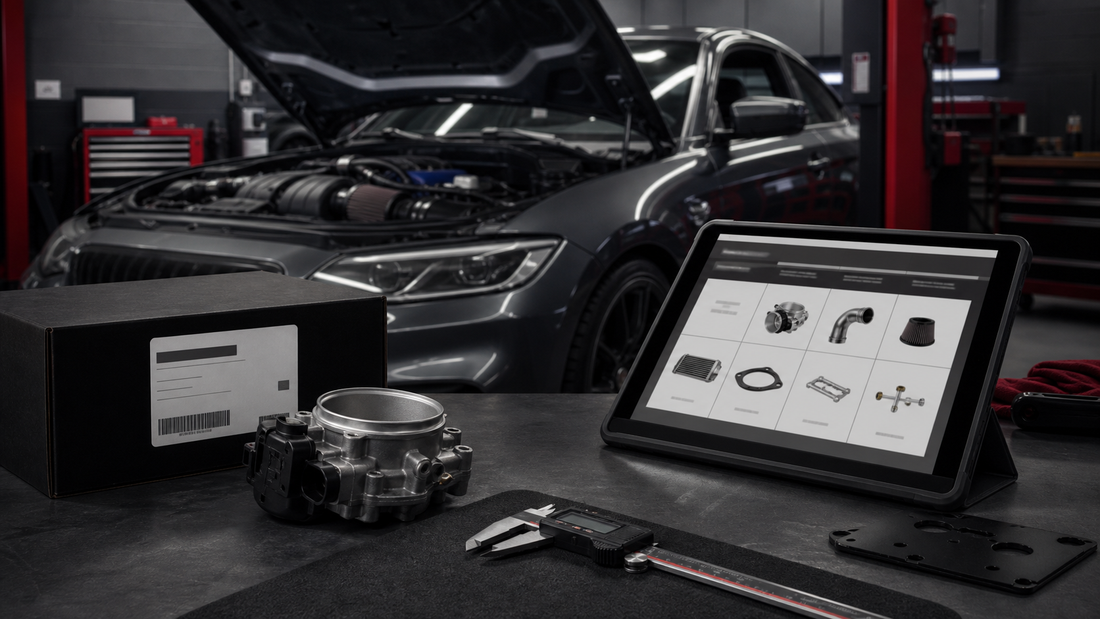
A blow-off valve vents compressed charge air to the atmosphere when the throttle closes. A bypass valve—also called a recirculation or diverter valve—routes that air back into the intake. Both reduce pressure reversal across the compressor, but the correct choice depends on how the engine measures air, how the ECU is calibrated, the turbo layout and local requirements. Sound alone is not a sufficient selection method.
Key takeaways
- MAF-equipped systems can depend on recirculation because the vented air may already have been measured.
- Speed-density systems may tolerate atmospheric venting differently, but calibration and application still matter.
- Valve size, location, control method and spring setup must match the turbo system.
- A loud release does not prove correct operation or additional power.
Why the valve is needed
When the throttle closes during a shift or lift, the turbo can still be moving air while the engine's airflow demand drops sharply. Pressure builds between the compressor and throttle. A correctly operating valve opens under the appropriate pressure differential and gives that air an escape route, reducing compressor surge and helping the system transition smoothly.
The valve is not the same as a wastegate. A wastegate controls turbine-driving exhaust gas to regulate boost under load; a blow-off or bypass valve manages charge air during throttle transitions.
How a blow-off valve works
A vent-to-atmosphere valve opens and discharges charge air outside the intake system, creating the familiar release sound. It requires a suitable mounting flange, adequate flow capacity, a correct reference signal and a spring or control strategy matched to manifold conditions.
If the ECU has already measured and fueled for that air, venting it can temporarily disturb mixture and drivability. Effects vary by platform and calibration.
How a bypass valve works
A bypass valve routes released air to the intake upstream of the compressor. Recirculation can preserve the airflow accounting expected by many MAF-based systems and usually reduces noise. The return connection must be sized and positioned correctly, and hoses must resist collapse and heat.
| Decision factor | Blow-off valve | Bypass valve |
|---|---|---|
| Discharge path | Atmosphere | Back to turbo inlet |
| Sound | Usually louder | Usually quieter |
| MAF considerations | May disrupt already-metered airflow | Often preserves expected airflow path |
| Plumbing | No return hose | Requires suitable return connection |
| Best use | Application and calibration designed for venting | Systems designed for recirculation |
MAF vs. speed density
A MAF sensor directly measures incoming air, often before the turbo. If measured air is later vented, the ECU may briefly deliver fuel for air that no longer reaches the cylinders. A speed-density strategy estimates airflow from pressure, temperature, engine speed and calibration models, which can change the response to venting.
This distinction is only a starting point. Some vehicles use blended strategies, sophisticated torque models or electronically controlled valves. Follow platform-specific manufacturer and tuner guidance.
Valve control and spring selection
Traditional valves use boost and manifold-vacuum references acting against a spring. Electronic valves are controlled by the ECU. A spring that is too stiff can prevent the valve opening when needed; one that is too soft can leak under conditions the system must hold. Do not choose a spring by boost pressure alone unless the valve manufacturer specifically uses that method.
Use the supplied setup procedure and verify reference-line routing. Never insert unapproved check valves or tees that interfere with other critical controls.
Valve size and placement
Flow capacity should match compressor airflow and system volume. An undersized valve may not release pressure effectively, while an oversized product provides no automatic benefit. Placement depends on the charge path, throttle location, available flange and application engineering. Use the exact kit or adapter designed for the system where possible.
Diagnosing common symptoms
- Flutter on lift: can indicate pressure oscillation, but sound alone cannot identify whether it is harmful compressor surge or another behavior.
- Stalling or rich stumble: may relate to vented metered air, leaks, spring setup or calibration.
- Low boost: can result from a leaking valve, damaged diaphragm, poor seal or many unrelated boost leaks.
- Valve remains open: may involve spring choice, reference signal, debris, damage or electronic control.
Pressure-test the charge system using a safe platform-specific procedure and inspect the valve rather than replacing parts based only on sound.
How to choose the right valve
- Confirm exact vehicle, engine, turbo system and ECU strategy.
- Determine whether the original system recirculates and why.
- Verify MAF location and calibration requirements.
- Choose a vehicle-specific flange or correctly engineered adapter.
- Match valve flow capacity and control type.
- Follow manufacturer spring and reference-line instructions.
- Confirm emissions and noise requirements for the intended use.
Common mistakes
- Choosing solely for sound.
- Confusing the valve with a wastegate or boost controller.
- Venting air on a system calibrated for recirculation without expert guidance.
- Using the wrong spring or stacking springs.
- Connecting the reference line to an unsuitable source.
- Ignoring O-rings, flange flatness and return-hose leaks.
- Assuming every flutter sound is normal.
Browse FSP blow-off valves and the broader forced-induction collection. Confirm the exact product application, control method and calibration requirements before ordering.
Frequently asked questions
Does a blow-off valve add horsepower?
It is primarily a pressure-management component. It does not create engine airflow or power by itself.
Can I make a bypass valve vent to atmosphere?
Only if the hardware, airflow strategy and calibration support it. Do not modify the path solely for sound.
Is compressor flutter always dangerous?
Different sounds can have different causes. Diagnose the system and follow turbo and valve manufacturer guidance.
Can the wrong spring cause a boost leak?
Incorrect setup or a damaged seal can prevent proper closure. Use the valve's documented procedure.
Safety note: Charge systems contain pressure and hot components. Allow cooling, depressurize safely and use correct clamps, seals and professional calibration support.